What We Learned at This Year’s Annual Housing Market Report
The Annual Housing Market Report
Each year, the Gallatin Valley Annual Housing Market Report brings together local real estate professionals to examine the data shaping housing both here in Montana and nationwide. The goal is to better understand the trends affecting affordability, market health, and buyers and sellers.
Last month, these industry leaders dove into migration trends, ownership costs, demographic shifts, the broader economic impact of real estate within Montana, and shared perspectives around today’s market.
Consider this the inside scoop, an all-access pass to what industry professionals are paying attention to right now, why it matters locally, and what you, as a buyer or seller, should take away from it.
All statistics referenced below are from the 2026 Gallatin Valley Annual Housing Market Report unless otherwise noted.
How Affordability Is Shaping the Market
A theme that stood out within this year’s report was affordability, specifically for first-time buyers and households earning under $100,000 annually.
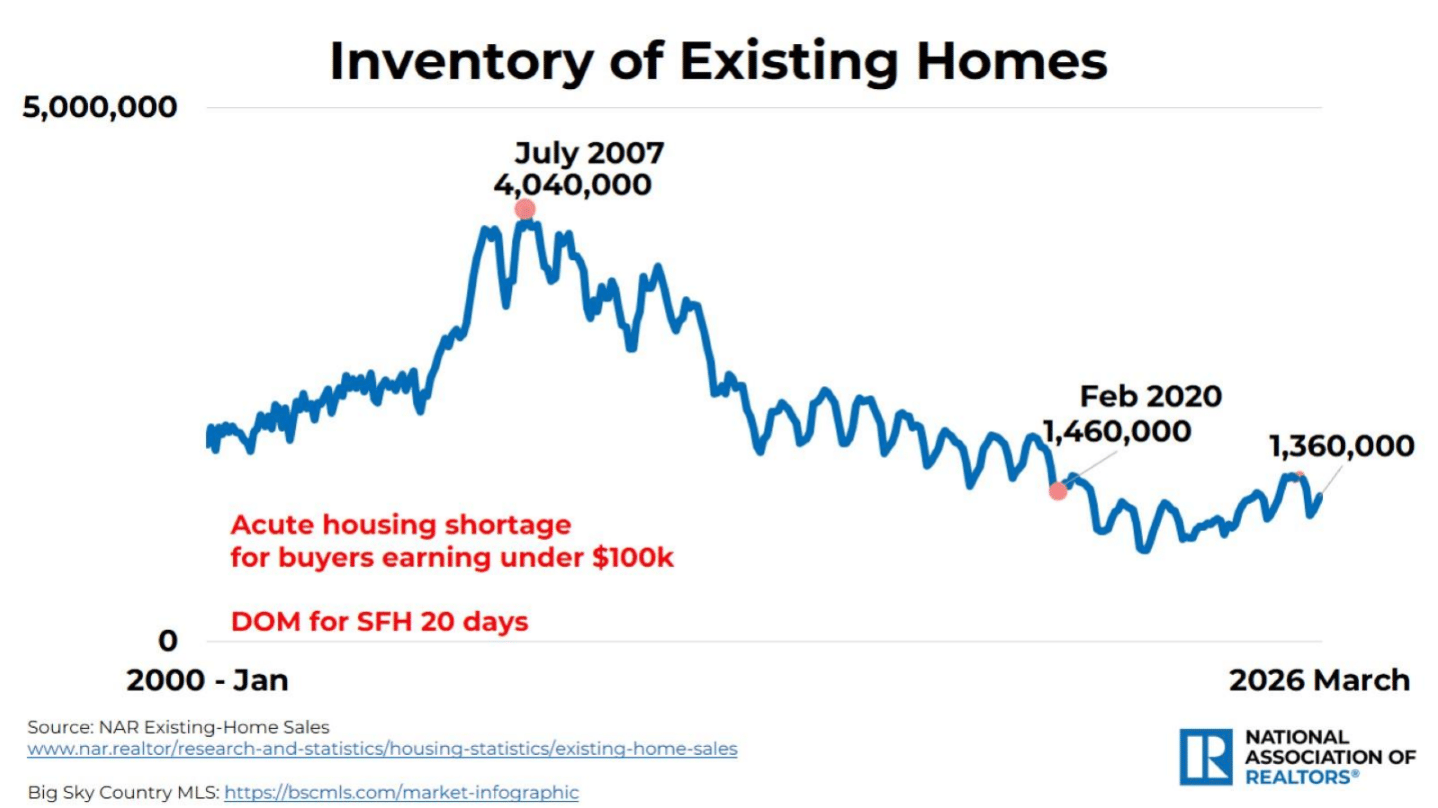
The report discussed how the inventory of existing homes continues to lessen: a national decline from 1,460,000 available homes in February of 2020 to 1,360,000 homes in March of 2026. This shortage was felt most by those with lower price points.
Simultaneously, the total cost of ownership has sharply increased in Bozeman’s metro area. While mortgage rates remain relatively close to the historical norm, rising home prices, along with an annual property tax increase of roughly $2,600 in 2019 to $4,500 in 2024, and monthly escrow costs rising nearly 74%, drastically affect affordability.
This year’s report also detailed that median homeowner tenure hit 11 years in 2025-2026, the highest figure on record. Homeowners are committing to properties longer, a huge factor in this being historically low mortgage rates or meaningful equity positions. In turn, available inventory is limited for buyers.
Sourced from 2026 Gallatin Valley Annual Housing Market Report
Montana’s High Demand Market
Even as affordability shifts, Montana’s housing market remains one of long-term high demand. The Annual Report detailed the state’s home prices experiencing a 71.8% increase between Q1 2020 and Q4 2025, the eighth-highest appreciation in the nation. Throughout the U.S., states in the Sunbelt and Mountain West continue to lead population growth trends. Montana gained 7,137 new residents in the last year alone, a 0.6% overall increase.
It’s this same demand that supports property values throughout the region, especially in markets like Bozeman, where outdoor access and lifestyle are major draws. Bozeman also sees a substantial share of all-cash buyers, accounting for 25.5% of local purchases with a median buyer age of 51. Of the total cash purchases, 8% were repeat buyers, news that reflects the growing benefits that existing equity can bring in today’s market.
How Do Today’s Buyers Look Different From Those of 40 Years Ago?
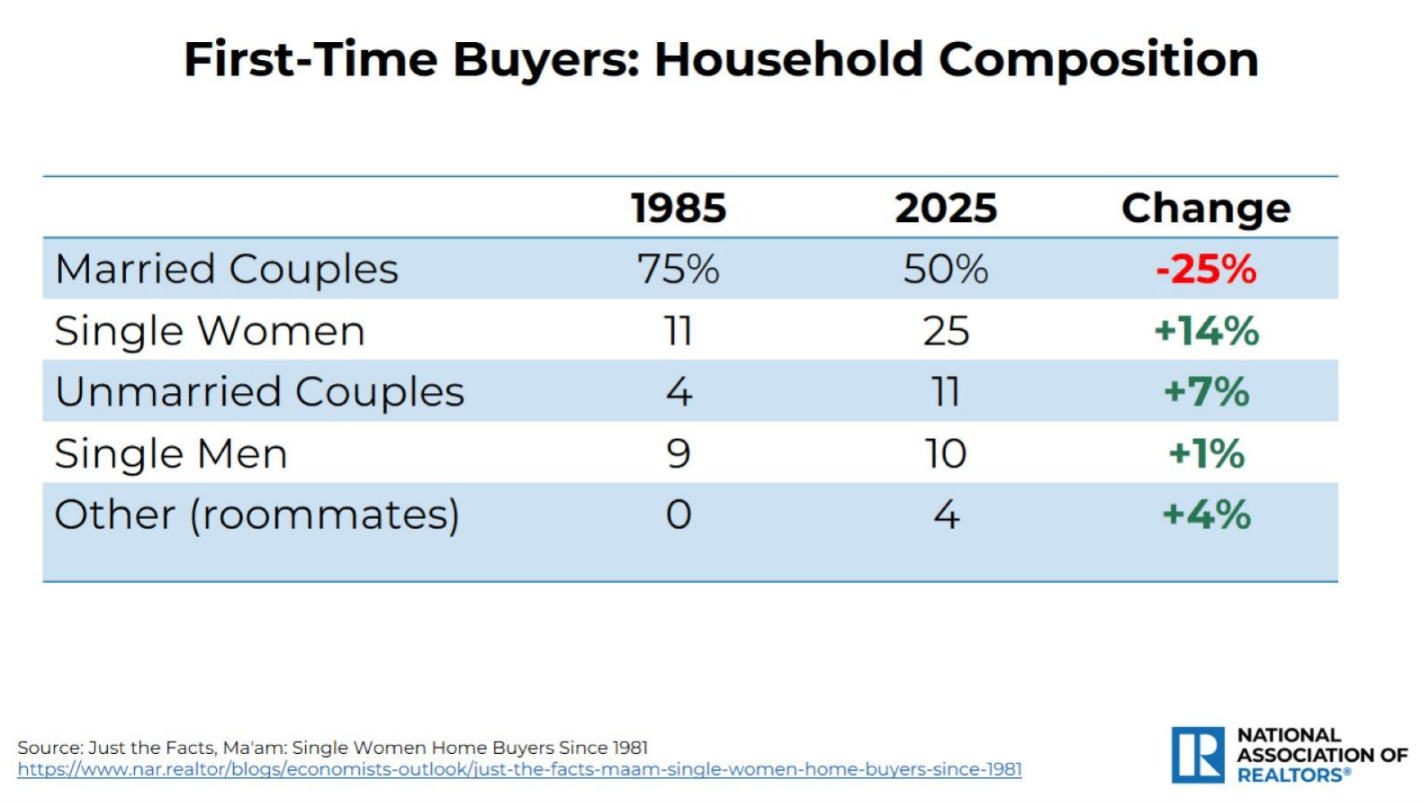
One of the most interesting pieces of information we walked away with from this year’s report was how much buyer demographics have shifted over time, and what this means. In the past year, first-time homebuyers have reached a national all-time low, sitting at only 21% of total buyers. The makeup of buyer households has also changed significantly since 1985, including the following statistics:
Married couples made up 75% of buyers in the past, compared to roughly 50% today.
The purchasing demographic for single women has risen from 11% to 25%, with unmarried couples increasing from 4% to 11%, and other buyers, like roommates purchasing together, have grown from none of the buyer market to 4%.
A sharp decline in “Baby-Bust” buyers, a generation facing lower birth rates, high debt, delayed marriage, and financial crises, all of which have contributed to greater barriers to first-time homeownership.
Buyers with children dropped from 58% in 1985 to just 24% in 2025.
The median buyer age of 51 years old indicates an older buyer demographic.
All in all, this data shows that homeownership and today’s buyer demographic look drastically different from those of past generations. Buyers are being forced to adapt to affordability demands by making lifestyle shifts and accounting for new financial realities.
Sourced from 2026 Gallatin Valley Annual Housing Market Report
Why Professionalism Is Still Just as Necessary Today
While an abundance of information is easily accessible online today, the vast majority of buyers and sellers are still choosing to navigate the market with real estate professionals.
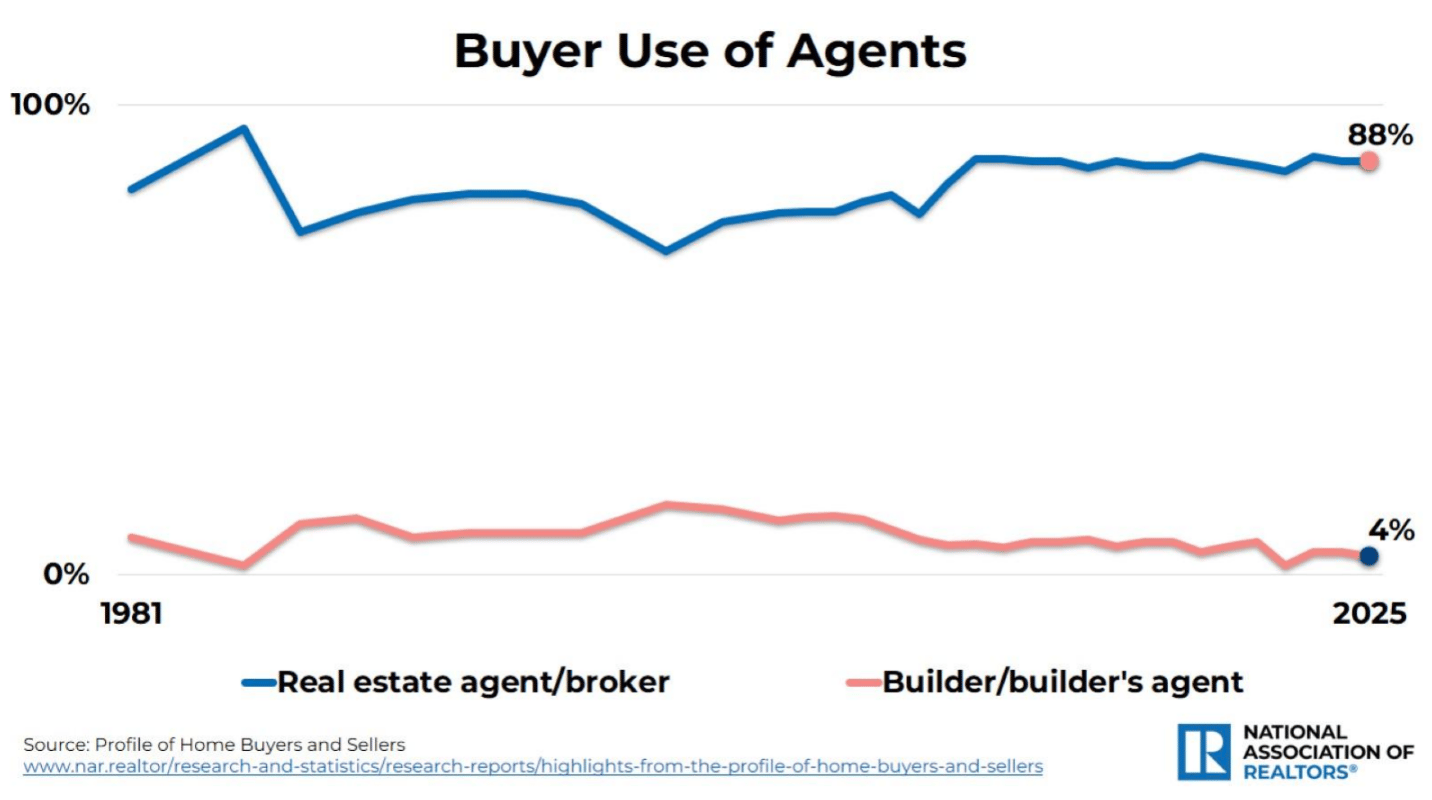
This year’s Annual Housing Market Report tells us that 88% of buyers used a real estate agent or broker in 2025, with just 4% purchasing through their builder or builder’s agent. For-sale-by-owner transitions also hit historic lows this year: 91% of sellers worked with agents while only 5% chose to sell independently.
This shift likely reflects the growing complexity of today’s market, including affordability, financing, pricing, inspections, negotiations, and ownership costs.
Continued education is essential in this business. Buyers and sellers are wisely seeking guidance that goes beyond an online property search. With constant market fluctuations, a major part of our work involves staying informed on the broader economic picture and market trends shaping local real estate decisions.
Sourced from 2026 Gallatin Valley Annual Housing Market Report
This Matters for More Than Housing
One of the biggest reminders in this year’s report was how big the broader impact of real estate is on Montana’s economy. It’s estimated that the economic implications of a single home sale in our state sit at approximately $195,130, and the real estate industry as a whole accounts for $17.4 billion, almost a quarter or 21.1%, of Montana’s economy.
These real estate market trends are affecting much more than buyers and sellers; they’re setting the economic conditions for small businesses, construction-related fields, lenders, infrastructure, and the long-term growth of the communities we’re all part of.
What To Watch Moving Forward
No report can perfectly predict the future, but a few themes were clear front-runners this year:
Affordability is likely to become a larger conversation.
Declining inventory could continue as homeowners hold onto properties longer.
Ownership costs need to be weighed as heavily as purchase prices.
Montana will continue seeing long-term demand compared to the rest of the U.S.
Understanding a property's total monthly cost, not just its listing price, has become more important for buyers. Similarly, strategically pricing and keeping a pulse on current buyer sensitivity remains essential for sellers.
Above all, this year’s report reinforces the importance of staying informed. Markets will always shift, and knowing both national and local trends well will help buyers and sellers make informed, sustainable long-term decisions.
Navigating These Changes With Parent Properties
It’s our job to stay informed, and we take it seriously. While we work in local Montana real estate, we understand that our market is shaped by broader national outcomes. The Annual Housing Market Report and other events like it give us context for where we stand today, and what we should be paying attention to.
If you’d like to talk through what these factors mean for you, whether buying or selling, consider this your invitation to contact me and get the conversation started. It’s my privilege to help you navigate the Bozeman market and make Montana home.